Phyn
Overview & Architecture
Pre-Market Prototype
Production Architecture
CES Launch
Scale & Team Transition
ClearSummit has a rare talent of understanding what they're building and what user context it needs to function with. This fosters a collaborative environment where both designers and developers can push boundaries.
Technical Challenges
Consumer IoT at Scale
Getting hardware, ML, cloud infrastructure and a mobile app to behave as one product in someone's house was harder than any of them on its own.

Bluetooth Provisioning
Device pairing in consumer IoT is notoriously fragile. Network timeouts, firmware states, user error. Dozens of failure modes that all need graceful recovery. We built a provisioning flow that handles edge cases users never see, with clear guidance when they need to act.

Real-Time Sensor Integration
Phyn's hardware generates continuous pressure data that feeds ML models running in the cloud. The mobile app needed to reflect that intelligence instantly, showing users what Phyn learned about their home as it happened, not minutes later.

Serverless Event Architecture
Water emergencies don't wait for servers to spin up. The alert path was designed as event-driven functions rather than a running service, so an alert does not wait on a server to start.
Platform Design
Intelligence Made Tangible
The challenge with smart home products is making invisible data feel real. Phyn knows things about your plumbing that you don't, and the app's job is to surface that intelligence in ways that feel intuitive, not overwhelming.
Learning Mode UX
Phyn's ML models need time to learn a home's water signatures. We designed an onboarding experience that turns this waiting period into engagement, showing users what Phyn is discovering about their plumbing in real-time.
Alert Hierarchy
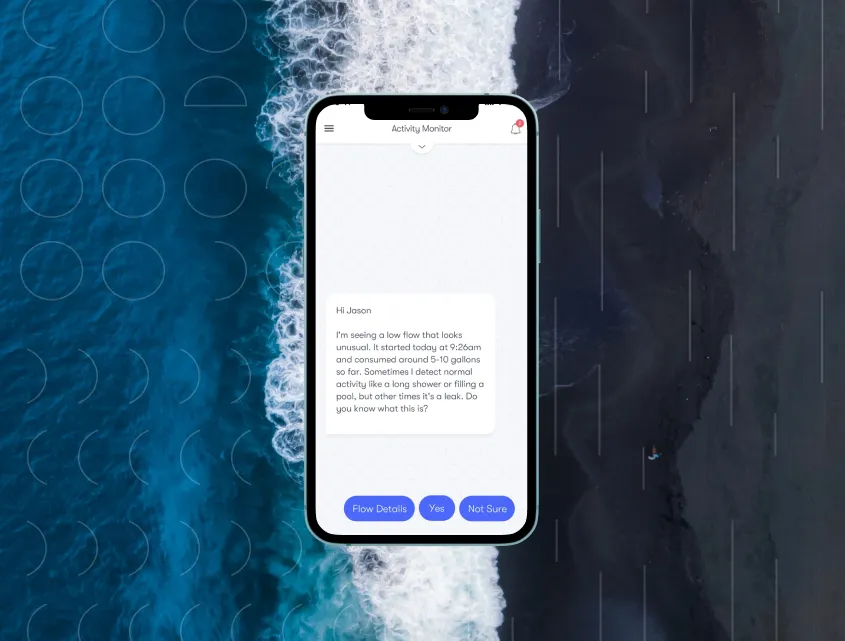
Not all water events are emergencies. We built a notification system that distinguishes between "your sprinklers ran longer than usual" and "shut off your water main now", with appropriate urgency in the UI.
Cross-Platform Consistency
The same intelligence, the same interactions, the same reliability across iOS, Android, and web. React Native for mobile, React for web, shared component libraries, unified design system.
Offline Resilience
IoT apps can't assume connectivity. We implemented offline-first architecture with sync, so users can review their water data and configure settings even when their network is down.
From Prototype to Platform
Build Your IoT Platform
If you are building something like this, tell us what you are trying to do.